Classroom Management – The Creation of a Positive Learning Environment

As we dive into the wonderful world of education – becoming fully licensed in our area of expertise, beaming with inspiration and readiness to improve the lives of all students, and the willingness to take on any and all challenges that we might face as new teachers – have you ever stopped to ask yourself, “What if I just can’t get through to my students? What if I do something to lose all respect and control in my classroom? What if other teachers look down upon me? What if I automatically turn into one of ‘those teachers’ who yell at students to constantly sit down and be quiet, becoming the negative person that everyone avoids? What if all of my efforts to become a licensed educator completely turn into failure?”

Ah, the jitters set in, as they always seem to, as these questions continue to persist in our minds. A fear of failure is not an uncommon one. Fortunately, life as a teacher does not have to turn out this way. With the proper tools and resources on successful classroom management techniques, we can begin to pave our way to victory on this journey. As a big believer of practice makes perfect, I also believe that applying our knowledge of effective classroom management skills can go a long way in shaping our success as educators, as well as the academic success of our students. 

Photo by NeONBRAND on Unsplash

Now that we are on our road to victory, the next few questions to ask are, “What are the different ways in which successful classroom management can be achieved? How do they differ based on grade-level and subject area? How does proper classroom management correlate with students’ academic achievement?” Let’s first take a look at one definition of classroom management.

“…management is about more than correcting the misbehaviors of individuals, more than just discipline. Classroom management is also about orchestrating or coordinating entire sets or sequences of learning activities so that everyone, misbehaving or not, learns as easily and productively as possible. Educators sometimes therefore describe good management as the creation of a positive learning environment, because the term calls attention to the totality of activities and people in a classroom, as well as to their goals and expectations about learning (Jones & Jones, 2007).”

Kelvin Seifert & Rosemary Sutton. (2009). Educational Psychology, 2nd Ed.

“The creation of a positive learning environment.” Sounds pretty great, doesn’t it? Not only will this type of setting be beneficial to the students’ academic success and overall development, it may also just be the reason why we become teachers in the first place – to positively impact our students. Now then, how can this level of utopia be achieved?

According to K. Seifert and R. Sutton, “The easiest management problems to solve are ones that do not happen in the first place!” (Educational Psychology, p. 140). What does this mean? Seifert and Sutton list the importance of “Arranging Classroom Space” – this includes seating charts, the layout of the furniture, and it is all dependent on what the subject matter is. Surely, a science classroom will be laid out differently than a language arts classroom, or a physical education class. The idea is to minimize distractions in order to focus on learning the subject matter as much as possible. Page 140 of Educational Psychology provides us with an interactive link to a virtual classroom layout activity. Try it out – it’s fun to envision your future classroom!

Photo by Charisse Kenion on Unsplash

Below is a statement from an article titled “Classroom Management That Works” by Robert Marzano. He talks about a specific research study that was done on this topic. In conclusion to this research, as emphasis is made on the “withitness” or the constant awareness and anticipation of student behaviors. What are your thoughts on this study?

“Arguably, the first high-profile, large-scale, systematic study of classroom management was done by Jacob Kounin (1970). He analyzed videotapes of 49 first and second grade classrooms and coded the behavior of students and teachers. Kounin’s findings…he identified several critical dimensions of effective classroom management. Those dimensions (among others) are (1) ‘withitness’, (2) smoothness and momentum during lesson presentations, (3) letting students know what behavior is expected of them at any given point in time, and (4) variety and challenge in the seatwork assigned to students. ‘Withitness’ involves a keen awareness of disruptive behavior or potentially disruptive behavior and immediate attention to that behavior; of the four dimensions, it is the one that most consistently separates the excellent classroom managers from the average or below-average classroom managers.

Robert Marzano. (2003). Classroom Management That Works.

In this article, Marzano also provides us with a visual of the impact of teacher effectiveness on student achievement.

Robert Marzano. (2003). Classroom Management That Works.

Continuing with the notion that successful classroom management leads to students’ academic success, let’s take a look at Classroom Management Strategies: Gaining and Maintaining Students’ Cooperation, by James S. Cangelosi. Cangelosi’s article also has some great case-by-case classroom scenarios.

“By applying fundamental classroom management and discipline techniques, teachers can lead students to be engaged in learning activities for more than 90% of the allocated time (Cangelosi, 1990, pp. 13-20; Evertson, 1989; Fisher et al., 1980; Jones, 1979).”

James S. Cangelosi. (2014) Classroom Management Strategies: Gaining and Maintaining Students’ Cooperation.

Consider another similar research study on “Effective Classroom Management Strategies and Classroom Management Programs for Educational Practice

“The findings revealed that teachers’ classroom management practices had a significant, positive effect on decreasing problem behaviour in the classroom. Students were less disruptive and showed less inappropriate and aggressive behaviour in the treatment classrooms compared with the control classrooms.”

Hanke Korpershoek, Truus Harms, Hester de Boer, Mechteld van Kuijk,
Simone Doolaard. (2014). Effective classroom management strategies and
classroom management programs for educational practice.
Photo by Feliphe Schiarolli on Unsplash

I would love to hear your thoughts and experiences with classroom management strategies. What do you think are most vital skills for success? What kind of adjustments need to be made in our classroom management style if we are educating students who have individual differences, such as different cognitive styles (aka learning styles), or students who are gifted and talented (interesting article from the Moodle course page on this, providing an overview of Dos and Don’ts), students who have learning disabilities, students who have physical or development disabilities, students who are English language learners, or come from different socio-economic backgrounds? The list goes on and on.

Let’s also not forget Lev Vygotsky’s “Social Development Theory” which states that community plays a central role in the process of “making meaning” in a child’s life. Based on this theory that social learning precedes development, we can recognize that each child may have a unique social upbringing, which may be something to consider when thinking about classroom management.

Sources:

Kelvin Seifert & Rosemary Sutton. (2009). Educational Psychology, 2nd Ed.

Scholastic. (2019) Classroom Set-Up Tool. http://teacher.scholastic.com/tools/class_setup/

Robert Marzano. (2003). Classroom Management That Works. https://books.google.com/books?hl=en&lr=&id=BVM2ml2Q-QgC&oi=fnd&pg=PA1&dq=classroom+management&ots=GepQ7SUfRW&sig=mmz2mSuCZBm0uya1T9KhXwxWOdU%23v=onepage&q=classroom%20management&f=false#v=snippet&q=classroom%20management&f=false

James S. Cangelosi. (2014) Classroom Management Strategies: Gaining and Maintaining Students’ Cooperation. https://books.google.com/books?hl=en&lr=&id=rC8IDAAAQBAJ&oi=fnd&pg=PR17&dq=classroom+management+strategies&ots=CXtbq9ufg1&sig=iy1dIjW3RV_RS9eFLVTJY0X8CoY%23v=onepage&q=classroom%20management%20strategies&f=false#v=snippet&q=classroom%20management%20strategies&f=false

Hanke Korpershoek, Truus Harms, Hester de Boer, Mechteld van Kuijk,
Simone Doolaard. (2014). Effective classroom management strategies and
classroom management programs for educational practice. http://hankekorpershoek.nl/wordpress/wp-content/uploads/2015/07/PDF-GION-rapport-Effective-Classroom-Management.pdf

George Lucas Educational Foundation. (2019) Serving Gifted Students in General Ed Classrooms. https://www.edutopia.org/blog/gifted-students-general-ed-classrooms-elissa-brown

McLeod, S. A. (2014). Lev Vygotsky. Retrieved from http://www.simplypsychology.org/vygotsky.html http://www.mrmikkola.com/uploads/1/0/5/7/10576731/simplypsychology.org-vygotsky.pdf

Behavior Management: Bringing Out the Best in Students

I walk into the classroom to pull out my 1st grade student. I call out his name, wave, and smile. He rolls his eyes and ever-so-slowly pushes back his chair to stand up. If I didn’t know better, I’d think he was heading to a funeral or an execution, not a tutoring session. Shoulders slumped and head down, he shuffles over to the door.

Once we’re out in the hall, he puts his hands on his hips and glares up at me.

“I’m mad at you,” he says.

“Why is that?” I ask.

“Because you don’t let me do whatever I want!” Satisfied with his zinger, he clambers up the stairs on all fours to head to the reading room for literacy tutoring.

Let me do whatever I want… Or else!
Picture by Ryan Franco from Unsplash

When I left the world of customer service to begin working in schools, I made the greatest miscalculation of my life. I thought that outbursts from children would be easier to deal with than outbursts from adults. My logic was that a child with behavior problems presents an opportunity for learning, growth, and change; while an adult’s tendencies are more “fixed”. I had yet to realize that a child’s moral development, as theorized by Lawrence Kohlberg, also plays a role. A child at a pre-conventional level of development may truly believe that they are entitled to do “whatever they want.” Any other outcome is morally unjust!

Cue a school-year full of unsuccessful attempts to deal with student behaviors ranging from shouting, swearing, and throwing things to bullying, violence, and everything in between. I was in over my head!

Help!
Photo by Ian Espinosa on Unsplash

But I wasn’t alone. In one middle school class where I subbed, I saw that the sub from the day before (who shall remain anonymous) had written the following note:

Today was not the students’ best day! I would liken it to being in the middle of a wolf pack, where each hour is just slightly more ravenous than the previous. Even glorifying the few students actively participating backfired, and they started being picked on. I would almost say these students are ruthless in their desire not to learn. Spring fever is an understatement.

Anonymous

Did he just say that?!
Photo by Jamie Haughton on Unsplash        

Most students are not ravenous wolves all the time. How do we manage classrooms and create a safe learning environment that tames the beasts and brings out the best in students? I think that one factor is attitude. Seeing the students as a wolf pack is a great way to set yourself up for failure.

Why not at least think of them as puppies?
Photo by Judi Neumeyer on Unsplash

Over the course of the school-year, different schools and classrooms each had their own system of incentives and consequences in place for behavior management. And every teacher I talked to had a different idea of how a classroom should be run. What surprised me was the number of teachers who used punishment as a tactic (predominantly either by yelling at students or kicking them out of the classroom).

I couldn’t help but wonder… Is this the best way?

And so began my quest to learn about behavioral psychology and its applications in the classroom. More importantly, how can strategies such as positive behavior support and restorative justice be used to simultaneously improve classroom behavior and support student well-being?

Behavioral Psychology

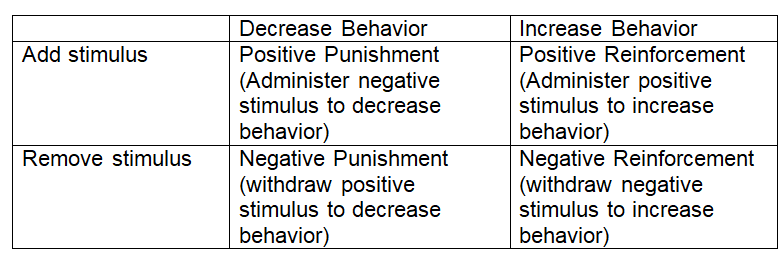
Working in a classroom, there are some behaviors that I want to see more often in my students, such as hand-raising, kind words, and active listening. But there are other behaviors that I want to see less often, such as violence, chair-throwing, and climbing out the window. According to B.F. Skinner, you can reinforce a desirable behavior by administering a positive stimulus (a reward) when that behavior occurs. Alternatively, you can decrease an undesirable behavior by punishing it (administering a negative stimulus).

For example, if you give a sticker to a student who raises their hand, they’ll be more likely to raise their hand in the future. If you scold a student who interrupts, they’ll be less likely to interrupt in the future. You can also do negative reinforcement by withdrawing a negative stimulus (no homework today because you were so well-behaved!) and negative punishment by withdrawing a positive stimulus (you don’t get free time today because you were standing on the teacher’s desk!). 

Just got positively reinforced! Woo, I feel great!
Photo by Mert Guller from Unsplash
Punishment’s getting’ me down…
Photo by Matthew Henry from Unsplash

Here’s a chart I made for all you visual learners:

Seems simple, right?

If it were that easy, then we’d be able to solve all the world’s problems by handing out stickers and assigning time-outs. Unfortunately, operant conditioning has some limitations. For example, within a classroom, numerous stimuli besides those presented by the teacher can serve to reinforce or punish a behavior. What if a student says something inappropriate, and the whole class laughs and applauds? Or what if a student gives the right answer and then gets teased by their classmates? Not to mention that behaviorism doesn’t account for hereditary and cognitive factors (McLeod, 2018).

Cherry (2019) explained how punishment in particular has several drawbacks. The behavior changes resulting from punishment are often only temporary, and punishment is ineffective if it isn’t consistently applied. Punishment also doesn’t provide any indication of what a proper alternative behavior would be. It’s a lot harder to stop eating greasy foods if you don’t have anything healthy to replace them with.

Digging deeper

Although behaviorism has its limitations, the world is filled with resources to help us learn about other ways to manage our classrooms. Consider this long list of behavior management resources from Edutopia. Even Dwayne the Rock Johnson has tips!

In addition, there are small steps we can take to minimize the chaos in our classrooms and make them into safe, productive spaces. Mulvahill emphasizes the benefits of having a strong classroom management plan with consistent, reliable routines. She also describes the importance of building relationships:

Get to know your students. What are their strengths? Their challenges? What are they really into? Investing in them as individuals builds trust, and that is the key to successful classroom management. Integrate social-emotional learning into your day. Teaching your students social-emotional skills builds a cohesive classroom community

Mulvahill, 2018

Two practices that I really want to highlight are Positive Behavioral Interventions and Support and Restorative Justice. Since these are both school- or district wide programs, you might not be able to officially implement them in your classroom without administrative support. However, both have individual elements that would be fantastic to incorporate.

Positive behavioral Interventions and Support

Lee states that Positive Behavioral Interventions and Support (PBIS) is based on educating students about good behavior. This makes expectations clear so that students are more easily able to meet them. This schoolwide system of shared expectations is intended to prevent rather than correct behavior issues. For students who do have behavior problems, the school works to create strategies so that those behaviors aren’t repeated. Evidence-based interventions are used for children who continue to experience problems. As explained by Lee, “In PBIS, schools still use discipline, but punishment isn’t the focus. The focus is on teaching expectations and preventing problems” (2019). More information about PBIS can be found here courtesy of Understood or here at the website for the Technical Assistance Center for PBIS. 

Restorative justice

Another strategy that all the bees are buzzing about is restorative justice. With an emphasis on relationships and community, this strategy is based on encouraging students to take responsibility for their actions, mediate conflicts, and make amends to anyone harmed by their actions. Using this approach instead of a traditional punitive approach can have a major impact. For example, one school district saw their suspensions decrease by 87% over three years after implementing a restorative justice program (We Are Teachers, 2019).

You can learn more about restorative practice by either reading this article or watching this video.

Photo by Perry Grone from Unsplash

Prevalence of Punitive Strategies

One of the biggest problems with using punishment as a behavior modification strategy is that school disciplinary policies are contributing the to the school-to-prison pipeline. So with options such as positive reinforcement, positive behavior support, and restorative justice at our disposal, why do punishment and discipline still persist in our nation’s schools? Why do so many teachers resort to these strategies?

As a closing thought, I’d like to reflect on the 1989 film Lean on Me. In the film, the principal played by Morgan Freeman was portrayed as an inspiration—but he carried a baseball bat and a bullhorn, expelled hundreds of students, and put chains on school doors, among other things. Would this film be as well-received in 2019, 30 years after its original release? Do you think that punitive, zero-tolerance policies are justified in a school district facing extreme challenges?

Also comment and share your own behavior management strategies! How do you encourage students to make responsible choices?

Each week we have new guest bloggers, follow us to stay in the loop – just click the follow button on the lower righthand side.

References:

Cherry, K (6 May 2019). Punishment in Psychology: How Punishment Can Be Used to Influence Behavior. Retrieved from https://www.verywellmind.com/what-is-punishment-2795413.

Lee, A.M. (2019). PBIS: What You Need to Know. Retrieved from https://www.understood.org/en/learning-attention-issues/treatments-approaches/educational-strategies/pbis-how-schools-support-positive-behavior.

Maxime, F. (2018, January 18). Zero-Tolerance Policies and the School to Prison Pipeline. Retrieved from http://www.sharedjustice.org/domestic-justice/2017/12/21/zero-tolerance-policies-and-the-school-to-prison-pipeline.

McLeod, S. (2013). Kohlberg’s Stages of Moral Development. Retrieved from https://www.simplypsychology.org/kohlberg.html.

McLeod, S. (2018). Skinner – Operant Conditioning. Retrieved from https://www.simplypsychology.org/operant-conditioning.html.

Mulvahill, E. (2018, February 12). What Is Classroom Management? Retrieved from https://www.weareteachers.com/what-is-classroom-management/.

We Are Teachers. (2019, January 15). What Teachers Need to Know About Restorative Justice. Retrieved from https://www.weareteachers.com/restorative-justice/.

Can Society-Based Factors Help Diminish the Achievement Gap? A Look Into an Ecological Approach

Each week we have new guest bloggers, follow us to stay in the loop – just click the follow button on the lower righthand side.

Photo by Lightspring on shutterstock

You may have heard of something called the achievement gap, defined by the National Education Association “as the differences between the test scores of minority and/or low-income students and the test scores of their White and Asian peers.”

Maybe you heard it on the news, or this little thing called the Nation at Risk which came out in 1983 and called for the “reform of our educational system for the benefit of all.”

Now you may be thinking excitedly, yes! We finally see our problems and did something about our school systems, but have we actually improved it? Our Nations Report Card from the National Assessment of Educational Progress summarizes information from the standardized tests given to measure this. Depending on which achievement gap you are looking at you will get different results. Focusing on the White and African American results, the achievement gap has declined since the 1980s but is still large for all the resources we have available today. The graph below, which is interactive, shows the white and African American and white and Hispanic achievement gaps from the 1970s to 2012. As you can see, there is the general trend of decline, but some are still high in the achievement gap standard deviation. 


Graph by Stanford cepa from NAEP data

Typically, when we think of the achievement gap, we think of affluent versus underserved students which is defined as “students who do not receive equitable resources as other students in the academic pipeline, according to Nicholas Highe and Jennifer Fisher. Unfortunately, the idea of poverty being a culture has been blamed for the relationship between race and socioeconomic factors and student achievement when in reality, structural racialization has been a major player. 

At this point you may be thinking, if all students in a school have access to the same resources and teachers, then why is the achievement gap still a big deal? Shouldn’t it almost be eliminated by now? On the surface one would think that, but we now know it is much more complicated than just doing better on a standardized test. 

So, what is affecting the achievement gap? This is the big question I wanted to know. We need to reach that deeper learning on how these problems are affecting our students and our possible implicit bias. The idea that poverty is a culture can play a role in this debated topic which is why as educators we need to reflect and seek the truth in how learning can be affected by these basic needs our students may not be getting.  This is why we need research. Being educated on topics we may think we know everything about is important in the field of education because we really only know the tip of the iceberg.

My next questions were how are nutrition and early resources at home affecting development? How does this development then play a role in learning? How is this learning then ultimately affecting the achievement gap? Let’s break this down.

We know food is important for our survival, but how does it affect our learning? According to Wilder Research, poor nutrition can lead to negative effects on students’ thinking and behavior in which leads to academic performance. Have you ever tried taking a test while your stomach was rumbling and found yourself fantasizing more about a steak dinner than your test? Imagine dealing with this everyday while being in class. Are you going to be paying attention to your teacher or your stomach? Not only does poor nutrition impact concentration, but also energy levels and brain function.

Without fuel for your brain, according to Fernando Gómez-Pinilla’s work from 2008,

“the ability of food-derived signals to influence energy metabolism and synaptic plasticity and, thus, mediate the effects of food on cognitive function.”  

Gómez-Pinilla, F. (2008). Brain foods: the effects of nutrients on brain function. Nature Reviews. Neuroscience, 9(7), 568–578

So, what does this mean? When we aren’t providing our brain with good nutritional food, our brain isn’t working at full capacity. That means the kind of foods our students are eating also affect learning and development. In the society we live in today, it is cheaper to buy less healthy foods like fast food restaurant products then it is to buy wholesome food at a grocery store. Under these conditions, underserved students may not get enough food, let alone the healthy foods their brains need for proper learning.  

Photo by TijanaM on shutterstock

The next question I wanted to know was how home resources may affect learning. If a student comes from a home where learning and reading were encouraged, lots of toys were provided for learning and developmental key stages, they will be much more prepared when starting school and possess the skills and development needed for their successful school career. A lack of educational materials for low income students produce low cognitive stimulation and enrichment (Wondering what these are?). Many agree that underserved students’ homes do not have these resources and experiences needed for proper cognitive development.

This also can include interactions with parents which can be key in cognitive development and learning. Christie Blazer provides some staggering statistics you can check out under the lack of educational activities and materials heading. Social, self, and moral developmental theories from Erik Erikson, Abraham Maslow, Lawrence Kohlberg and Carol Gilligan also become important while students learn these other developments that can affect them overtime for life success (Need a brush up?). Resources in the home may be affecting development much more than one would expect.

If we think of everything that aids to proper cognitive development, which the book Educational Psychology by Kelvin Seifert and Rosemary Sutton refers to as

“a child’s development of information processing, conceptual resources, perceptual skill, language learning and other aspects.”

Kelvin Seifert, & Rosemary Sutton. (2009). Educational Psychology (2nd ed.).

As we can see, many of those skills are affected by the two ecological factors discussed.

Thinking of both Jean Piaget’s cognitive development theory and Lev Vygotsky’s social development theory (Need to learn more?), we could see how these may affect a student’s development and executive function (Also need to learn more about EF?). If underserved students don’t have the opportunity to develop cognition as a child or interact culturally with social members to learn higher mental processes, they may not be at the same level as fellow peers that were provided those ecological factors. Both cognitive development and EF can cause difficulties when it comes to learning creating different levels of ability among students of the same age. If all these factors are affecting learning and development, what else are they affecting? Yep, you guessed, the achievement gap.

To make this easier, we could think of the staircase model like in the picture below.

Photo by graphixmania on shutterstock

By now you must be thinking, okay so learning is affecting development, but how is development affecting the achievement gap? If the average development, according to Educational Psychology, happens by building off the last stage or step in a hierarchy as some theories state, then development occurs as a process or staircase.

If an underserved student gets a late start on their cognitive, social, self, moral, or ethical development, they may not be on the same said “stairs” as their average peers and are still dependent learners. If learning ability isn’t yet at the same step as their peers, guess what is left? An achievement gap.

Photo by Brovko Serhii on shutterstock

Here is another picture of a staircase, but do you notice what’s different? People are helping each other this time. Students and/or educators don’t need to feel like they have to tackle this problem all on their own. There are many classroom applications that can be used.

Collaborative learning can fill gaps in understanding between students who are independent learners to help dependent learners progress. We may need to provide underserved students with extra resources to create productive struggle. Activities could include hands on experiences or hypothetical questioning in order to generate and build brain power on the developmental stairs they are behind.

Scaffolding or giving students more organization in their tasks can help provide the push they need to challenge and grow their intellectual capacity.  The use of culturally responsive teaching and neuroscience can be applied to appropriately push the higher order thinking necessary for students to become independent learners.

Now of course there are always limitations. School budgets, teachers’ time constraints, individual situations and needs, outside of school factors all create variability in outcomes. But with the commitment of teachers, deep knowledge of brain-based principles and theories, and attentiveness of these risk factors, we can surely work on closing the achievement gap.

I would love to hear your thoughts on how we can support in providing some of the ecological factors that may be missing for underserved students. If we can assist in these, we can change the effect they have in development and in turn the achievement gap. Let me know your thoughts.

Interested in more factors that may be affecting our underserved students I didn’t discuss?

Each week we have new guest bloggers, follow us to stay in the loop – just click the follow button on the lower righthand side.

Sources:

A Nation At Risk [Evaluative Reports; Policy Guidance]. (n.d.). Retrieved from https://www2.ed.gov/pubs/NatAtRisk/risk.html

Blazer, C., & Romanik, D. (n.d.). THE EFFECT OF POVERTY ON STUDENT ACHIEVEMENT. 24.

Common Causes of the Achievement Gaps. (2018, March 2). Retrieved from Corwin website: https://us.corwin.com/en-us/nam/equity-causes-of-achievement-gaps

Gómez-Pinilla, F. (2008). Brain foods: the effects of nutrients on brain function. Nature Reviews. Neuroscience, 9(7), 568–578. https://doi.org/10.1038/nrn2421

Highe, N. (n.d.). School Counselors Bridging the Gap Between Colleges, Careers, Underserved Students and Their Families. 22.

Kelvin Seifert, & Rosemary Sutton. (2009). Educational Psychology (2nd ed.).

Learning to Read and Write: What Research Reveals | Reading Rockets. (n.d.). Retrieved from http://www.readingrockets.org/article/learning-read-and-write-what-research-reveals

Research, W. (n.d.). Nutrition and Students’ Academic Performance. 10.

Saul McLeod. (2018). Vygotsky | Simply Psychology. Retrieved from https://www.simplypsychology.org/vygotsky.html

Social development: relationships,personal motives, and morality | Educational Psychology. (n.d.). Retrieved from https://courses.lumenlearning.com/educationalpsychology/chapter/social-development-relationshipspersonal-motives-and-morality/

Students Affected by Achievement Gaps. (n.d.). Retrieved from NEA website: http://www.nea.org//home/20380.htm

The Educational Opportunity Monitoring Project: Racial and Ethnic Achievement Gaps. (n.d.). Retrieved from https://cepa.stanford.edu/educational-opportunity-monitoring-project/achievement-gaps/race/

yacobuca. (2019, May 16). Executive Function: building a toolkit to support teaching and learning about EF. Retrieved from summeredublog website: https://summeredublog.home.blog/2019/05/16/executive-function/

Zaretta Hammond. (2015). Culturally Responsive Teaching and The Brain. Sage Publications Ltd.

Time For Morality: making the case for teaching moral development

Each week we have new guest bloggers, follow us to stay in the loop – just click the follow button on the lower righthand side.

Well, I did it again. I ran out of time. In class yesterday, with topics spanning a variety of theories, systems, and processes of human development, I didn’t have time to address the formation of moral reasoning and its’ application to teaching and learning.

The fact is, I don’t think I’m alone.

As Paul Barnwell, teacher and writer based in Kentucky, writes in his poignant article about the lack of moral education being taught in schools today:

For many American students who have attended a public school at some point since 2002, standardized-test preparation and narrowly defined academic success has been the unstated, but de facto, purpose of their schooling experience. And while school mission statements often reveal a goal of preparing students for a mix of lifelong success, citizenship, college, and careers, the reality is that addressing content standards and test preparation continues to dominate countless schools’ operations and focus.

Barnwell, P. Students’ Broken Moral Compasses: The pressures of national academic standards have pushed character education out of the classroom. The Atlantic. (2016).

As a society, have we prioritized academic standards and test preparation at the expense of moral development?

A quick review of the history of moral education in the United States points to the ebb and flow of moral education, a movement toward value-free education, the packaging and repackaging of character education, and the current emphasis on social emotional learning.

In fact, the very turning point that Barnwell argues is responsible for pushing character education out of the classroom, No Child Left Behind included character education as a central aspect to education reform.

Photo by ahmad gunnaivi on Unsplash

This leads me to question:
-Is a focus on academic standards to blame or is something else standing in the way of moral education?
-Do teachers understand morality thoroughly enough to effectively facilitate learning experiences that foster its’ development?
-How can teachers make the time for moral education while also supporting academic rigor?
-Does this all come down to the fact that some professor ran out of time to address the importance of moral development during the one class dedicated to mentioning the topic???

Photo by Jon Tyson on Unsplash

In my attempt to answer these questions, I realized it’s pretty complex. Issues of fairness, empathy, trust, ethics, correctness, responsibilities, values, conduct, and judgements of what is right or wrong underscore just how complicated the construct of morality really is. Various interpretations exist among individuals, cultures, and societies.

So now what?

First, we need to learn more about morality.

The science of morality is an expanding topic of study among psychologists and neurobiologists. Discovery, a series by BBC World Service that explores the nature of science, produced a podcast titled “The Science of Morality.” During the episode, Dr. Carinne Piekema interviews leading psychology and neurobiology researchers who are working to break down moral beliefs into their component processes. Their research supports everything from teaching empathy to giving more hugs. (BTW, Hugs are always a good idea. We need more hugs. It’s a scientific fact!)

Second, we need to make small adjustments to what we’re already doing.

According to Teaching Tolerance:

Empathy and academics need not be mutually exclusive. In fact, a focus on empathy can increase student achievement. This toolkit for “Empathy for the ‘A’” shows teachers how to build empathy into their practice with a few adjustments to the things they already do.

Teaching Tolerance. Toolkit for “Empathy for the ‘A'”. (2016).

TT’s Toolkit for “Empathy for the ‘A'” supports teachers in making these small adjustments in their classroom through the use of student feedback, using games in the classroom, curriculum planning, setting goals, and building relationships.

Third, we need to get on board with the Social Emotional Learning (SEL) movement.

Another way to attend to moral education in the classroom is through the implementation of Social Emotional Learning. The Collaborative for Academic, Social, and Emotional Learning (CASEL) is a trusted source for knowledge about high-quality, evidence-based SEL. They provide a number of resources for educators including this systematic framework to identify, evaluate, and provide best-practices for SEL programs.

CASEL’s Framework for Systemic Social and Emotional Learning.

Lastly, we need to engage students in authentic learning experiences that address moral dilemmas.

Making space for classroom discussions that engage students in identifying and addressing community issues, societal problems, and social dilemmas is not only relevant and academically challenging, but offers opportunities for students to understand complex issues from multiple perspectives. This process of higher order thinking allows students to grapple with the contradictions inherent in human morality. When students obtain an awareness of moral judgements, they expand their own moral reasoning.

With this in mind, let me end with the classic moral dilemma that Kohlberg himself would propose to people to determine their morality of justice- The Heinz Dilemma. It goes as follows:

A woman was on her deathbed. There was one drug that the doctors thought might save her. It was a form of radium that a druggist in the same town had recently discovered. The drug was expensive to make, but the druggist was charging ten times what the drug cost him to produce. He paid $200 for the radium and charged $2,000 for a small dose of the drug. The sick woman’s husband, Heinz, went to everyone he knew to borrow the money, but he could only get together about $1,000 which is half of what it cost. He told the druggist that his wife was dying and asked him to sell it cheaper or let him pay later. But the druggist said: “No, I discovered the drug and I’m going to make money from it.” So Heinz got desperate and broke into the man’s laboratory to steal the drug for his wife.

Kohlberg, L. (1981). Essays on Moral Development, Vol l. I: The Philosophy of Moral Development. San Francisco, CA: Harper & Row. 

Now consider these questions:
-Should Heinz steal the drug? Why or why not?
-Suppose the person dying is not his wife but a stranger. Should Heinz steal the drug for a stranger? Why or why not?
-It is against the law to steal. Does that make it morally wrong? Why or why not?

I’d love to hear what you think. Share your comments below.

Sources:
Barnwell, P. (2016). The Atlantic. Students’ Broken Moral Compasses: The pressures of national academic standards have pushed character education out of the classroom. https://www.theatlantic.com/education/archive/2016/07/students-broken-moral-compasses/492866/

Collaborative for Academic, Social, and Emotional Learning. (2017). Framework for Systemic Social and Emotional Learning. Retrieved from: https://casel.org/wp-content/uploads/2017/01/CASEL-Wheel-2.pdf

Discovery. BBC World Service. (2012). The Science of Morality. Retrieved from: https://www.bbc.co.uk/programmes/p00rdps3

Kohlberg, L. (1981). Essays on Moral Development, Vol l. I: The Philosophy of Moral Development. San Francisco, CA: Harper & Row. 

McLeod, S. (2013). Kohlberg’s Stages of Moral Development. Retrieved from: https://www.simplypsychology.org/kohlberg.html

Stateuniversity.com Educator’s Encyclopedia. (2019). Moral Education: A Brief History of Moral Education, The Return of Character Education, Current Approaches to Moral Education. Retrieved from: https://education.stateuniversity.com/pages/2246/Moral-Education.html

Teaching Tolerance. (2016). Toolkit for “Empathy for the ‘A'”. Retrieved from: https://www.tolerance.org/magazine/spring-2016/toolkit-for-empathy-for-the-a

U.S. Department of Education. (2005). No Child Left Behind. Character Education: Our Shared Responsibility [PDF File]. Retrieved from: https://www2.ed.gov/admins/lead/character/brochure.pdf

Each week we have new guest bloggers, follow us to stay in the loop – just click the follow button on the lower righthand side.

Executive Function: building a toolkit to support teaching and learning about EF

by contributing blogger, Yaco

Each week we have new guest bloggers, follow us to stay in the loop – just click the follow button on the lower righthand side.

Photo by Alina Grubnyak on Unsplash

In a workshop that I attended today on the topic of trauma-informed teaching, the presenter explained that the absence of executive function (EF) in human cognition was like driving a Ferrari without brakes. This analogy really stuck with me. If executive function can be the difference between life and death, it’s critically important, but I wonder how well it is understood.  What do educators, administrators, school counselors, social workers, parents, and others that contribute to educating today’s youth really know about executive function? How is executive function taught in schools? How does our knowledge of executive function affect how we work with children at different ages and stages throughout their K-12 education?

Understood, a digital resource for learning and attention issues (you can learn more about their story here) defines EF as “a group of three skills that allow kids to manage their thoughts, actions, and emotions in order to get things done. They also enable kids to plan, manage time and organize.” Understood goes on to label the three groups of skills as 1. Working Memory, 2. Cognitive Flexibility, and 3. Inhibitory Control.  Understood provides a handy infographic that goes into greater detail about each skill set.

Okay, so EF helps us pay attention, critically think, and regulate a whole host of necessary life functions. Now that we have a better understanding of what EF consists of, how can we support its development?

The Center on the Developing Child at Harvard University provides a number of resources that can help us gain a better understanding of EF as it relates to development. One particular resource by the Center on the Developing Child, What Is Executive Function? And How Does It Relate to Child Development? explains that EF is a set of skills that must be learned throughout one’s childhood, adolescence and early adulthood.

Photo by Matt Antonioli on Unsplash

Stop right there. Put on the brakes (…in that dream Ferrari…that has brakes). EF is a set of skills. Okay, we get that. But what else did they say? EF is a set of skills that Must. Be. Learned.

Are they saying Piaget had it all wrong? Cognitive development does not happen in the same way as biological maturation?

Okay, okay, I’ve heard this critique of Piaget’s theory of cognitive development before. Social interaction is crucial for cognitive development. Of course children need to learn from parents, teachers, coaches, mentors or “More Knowledgeable Others” as another famous developmental theorists once put it (thank you, Vygotsky), but don’t we all kinda believe that as kids grow older, the mere act of maturing plays a role in their ability to pay attention, organize, plan, regulate emotions, and generally just keep track of what their doing?

I’ll be the first to admit it- I did.

The Center on the Developing Child addresses three popular misconceptions of science related to EF:

  1. Contrary to popular belief, learning to control impulses, pay attention, and retain information actively in one’s memory does not happen automatically as children mature, and young children who have problems with these skills will not necessarily outgrow them.
  2. Contrary to popular belief, young children who do not stay on task, lose control of their emotions, or are easily distracted are not “bad kids” who are being intentionally uncooperative and belligerent.
  3. Contrary to the theory that guides some early education programs that focus solely on teaching letters and numbers, explicit efforts to foster executive functioning have positive influences on instilling early literacy and numeracy skills.
Photo by Akshay Chauhan on Unsplash

These misconceptions highlight how a lack of understanding of child development, EF, or both can contribute to a whole host of barriers that will prevent children from obtaining EF, because we simply might not understand the importance of teaching EF skills, or worse yet, mistakenly believe that EF does not have to be taught at all. This seemingly simple mistake may contribute to the over-diagnosis of attention deficit disorders among children (wondering what the difference is between ADHD and Executive Functioning Issues? Understood has you covered for that, too.) Equally as alarming, this lack of understanding could even be attributing to the school-to-prison pipeline as “bad kids” receive less instructional time due to consequences for misbehavior that remove them from the classroom.

So now what?

Join me in building a toolkit to support teaching and learning about EF.

Understood and the Center on the Developing Child have lots of helpful resources. Another great resource with surprisingly practical tips for supporting students who struggle with EF is the Child Mind Institute. The University of Wisconsin-Madison has developed four modules to assist students in increasing self-awareness and improving the ability to pay attention and focus, which are related to the skills of EF. Also, The Institute of Child Development at the University of Minnesota is researching ways in which EF in children can be assessed to gain a better understanding of its relationship to learning and development. You can learn more about the Minnesota Executive Function Scale that has been developed by researcher, Stephanie Carlson, PhD at the U of M in this quick video:

All of these resources provide us with a greater understanding of EF, and the more we know about it, the more we will be able to teach the skills necessary for children to develop EF.

I’d love to hear your thoughts on executive function and the resources you may already have in your toolkit. Post your comments below.

Sources:

Understood for Learning & Attention Issues. (2014-2019). Our Story. Retrieved online from https://www.understood.org/en/about/our-story

Understood for Learning & Attention Issues. (2014-2019). 3 Areas of Executive Function. Retrieved from https://www.understood.org/en/learning-attention-issues/child-learning-disabilities/executive-functioning-issues/3-areas-of-executive-function

Understood for Learning & Attention Issues. (2014-2019). The Difference Between ADHD and Executive Functioning Issues. Retrieved from https://www.understood.org/en/learning-attention-issues/child-learning-disabilities/executive-functioning-issues/difference-between-executive-functioning-issues-and-adhd

Center on the Developing Child, Harvard University. (2019). What Is Executive Function? And How Does It Relate to Child Development? Retrieved from https://developingchild.harvard.edu/resources/what-is-executive-function-and-how-does-it-relate-to-child-development/

The Child Mind Institute. (2019). For Educators. Retrieved from https://childmind.org/audience/for-educators/

University of Wisconsin-Madison. Modules for Executive Functioning [PDF File]. Retrieved from https://www.uhs.wisc.edu/wp-content/uploads/modules-for-executive-functioning.pdf

McLeod, S. (2018). Lev Vygtosky. Retrieved from https://www.simplypsychology.org/vygotsky.html

McLeod, S. (2018). Jean Piaget. Retrieved from https://www.simplypsychology.org/piaget.html

Each week we have new guest bloggers, follow us to stay in the loop – just click the follow button on the lower righthand side.