Each week we have new guest bloggers, follow us to stay in the loop – just click the follow button on the lower righthand side.
If you are anything like me and the many experts that we have read about and listened to this week, you may agree that progressive education is something that is difficult to put into a single sentence (Ryan, 2017). It’s something that is better explained through a variety of educational experiences rather than a simple definition. I think many of us have grown up with the “traditional education” experience, so trying to imagine something different often causes some uneasiness. After watching the video “Changing Education Paradigms,” a speech written by world renowned education and creativity expert Sir Ken Robinson, I’m left wondering why we aren’t rethinking the educational experience for students (The RSA & Robinson, 2010).
In an effort to do justice to some of the foundational
educational thinkers of our time, please allow me to take you through some of
the theories behind progressive education. I will use constructivism as a lens
to shed light on one form of progressive education called place-based learning.
Before I get ahead of myself, let me start off with the meaning of
constructivism.
Constructivism is the view of learning through experience (Seifert & Sutton, 2009). For example, instead teaching students about biodiversity in plant species through books, lectures, and photos; constructivism would suggest that you bring students outside to count and document plant types as a means of anchoring learning in experience. There are two types of constructivism, psychological constructivism and social constructivism (Seifert & Sutton, 2009).
On the psychological side, humans learn through the experiences that they encounter. This aligns with Jean Piaget’s view, in which he states that humans bring their past experiences and apply their schema to new situations through assimilation. When the student’s schema does not align with the new situation, then they are put into disequilibrium. This is when the student uses accommodation to change or alter their thinking and to learn new material in order to bring them back to equilibrium. This results in the creation of a new schema (Seifert & Sutton, 2009).
Social constructivism lends itself to the theory of Lev Vygotsky, in which he states that we learn from interactions with people that are more capable. It is important to note that Vygotsky suggested the opportunity to learn is fostered by exposure to experts, who help to relate the new information to prior knowledge that is already meaningful to the student. The knowledge gap that exists between a novice and the more knowledgeable other, the teacher, is called the zone of proximal development. The focus of the teacher or expert is taking on the role of a guide or facilitator, providing the opportunity to learn, and tailoring instruction to match the students’ progress (Seifert & Sutton, 2009).
Lastly, I would be remiss if I did not mention John Dewey, who was said by many to be one of the main advocates of the progressive education movement. Dewey believed that learning should integrate the student into the decision-making process, or learning through democracy. The students’ talents, skills, and prior knowledge should help shape curriculum that is relevant and holds weight with the student (PBS). “John Dewey rejected the notion that schools should focus on repetitive, rote memorization & proposed a method of directed living” (UCD Teaching and Learning). He argued that learning done by doing is crucial to a child’s development (PBS).
So, by this point you are probably thinking, “Ok, thanks for
the refresher,” but I now want you to think about what you picture when I say
the word “classroom.”
Everyone have a mental image?
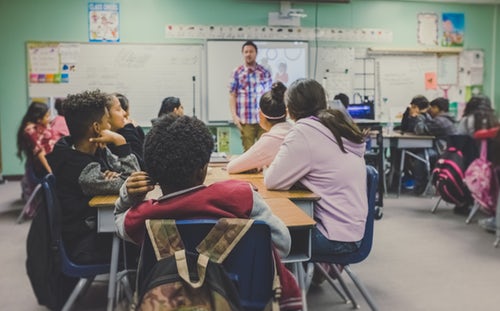
You probably thought of an indoor space, surrounded by a
couple of walls. Maybe sprinkle in some desks arranged in rows or small groups.
You may have pictured quiet students, a teacher at the front, a whiteboard,
some computers, maybe a SMARTboard or projector. Alright, let’s call this the CLASSROOM WORLD. Hold onto that term for
a moment.
Growing up in school, there always seemed to be that one
student in the class that would ask, “When will I ever use this?” or “What is
the REAL-WORLD application?” The
teacher would do their best to relate content information to skills in the real
world. The students would continue to learn the in-depth information, struggle
to recall it on the test, and shortly after forget portions of the material to
make room for new lessons.
What if I told you that by connecting the CLASSROOM WORLD and the REAL WORLD in the same place helps students to put content
material into practice to gain a more thorough understanding? Hammond
references this same idea when describing the third stage of information
processing (Hammond, 2015).
“The application stage focuses on giving the brain opportunities to apply [the] new knowledge through deliberate practice and real life application. Opportunities to apply what we have learned come through place-based learning, project-based learning, or problem-based learning and help solidify learning”
(Hammond, Z., & Jackson, Y. (2015). Culturally responsive teaching and the brain: Promoting authentic engagement and rigor among culturally and linguistically diverse students. Thousand Oaks, CA: Corwin, a SAGE Company. 127.
So, what is place-based learning? The Place-based Education Evaluation Collaborative defines place-based education as
“[an immersion] in local heritage, culture, landscapes, opportunities, and experiences as a foundation for the study of language arts, mathematics, social studies, science, and other subjects. Place-based education encourages teachers and students to use the schoolyard, community, public lands, and other special places as resources, turning communities into classrooms.”
Place-Based Education Evaluation Collaborative (PEEC). (2010). The Benefits of Place-Based Education: A Report from the Place-Based Education Evaluation Collaborative [Brochure]. Retrieved June 8, 2019. 2.
Looking at the context of how Hammond uses the term place-based learning, you may be thinking that schools already do this to some extent. Well, instead of just doing it occasionally, only a few times a year, let’s take place-based learning and put it as the focus by which schools revolve around on a daily basis. To see what this looks like in practice check out Hood River Middle School in Hood River, OR. (Edutopia & Hood River Middle School, 2016)
What are the Benefits for Students?
Students
that attend place-based learning schools are more engaged due to the hands-on
approach to learning. Engagement is one thing, but in today’s educational
climate focused on standardized test scores, how do these schools measure up?
The Environmental Middle School in Portland, Oregon, consists of more than 200 students in grades six through eight. The school focuses on natural processes and landforms as a means to teach social studies, science, math, and language arts. It has also been successful at attracting a diverse student population. The school’s location allows for students to use public transportation to take frequent field trips to connect their studies with place. Two days a week, classes take place in the natural landscape or community. The remaining days of the week are typical classroom days. “Students at the Environmental Middle School consistently perform at high levels in comparison to their peers in other schools, despite the fact that their teachers do not focus on test preparation” (Smith, 2002, p. 589).
A
study conducted by the Harvard Graduate School of Education for the Rural Trust
looked at the benefits for connecting students’ education with the local
community. The study evaluation concluded that as schools work together with
the community “students’ academic achievement improves, their interest in their
community increases, teachers are more satisfied with their profession, and community
members are more connected to the schools and to the students” (Powers, 2004, p.
18).
What are the Benefits for the Community?
Place-based
education anchors learning in the community and surrounding environment which
helps to validate students and the world that they come from. Whether a
students’ culture is more collective based or individual, this educational
approach makes learning relevant and meaningful by empowering students through
community projects and individualized instruction. Gregory Smith, associate professor for the Graduate
School of Education at Lewis and Clark College states,
“The primary value of place-based education lies in the way that it serves to strengthen children’s connections to others and to the regions in which they live. It enhances achievement, but, more important, it helps overcome the alienation and isolation of individuals that have become hallmarks of modernity. By reconnecting rather than separating children from the world, place-based education serves both individuals and communities, helping individuals to experience the value they hold for others and allowing communities to benefit from the commitment and contributions of their members.”
Smith, G. A. (2002). Place-Based Education: Learning to be Where We Are. Phi Delta Kappan, 83(8), 594.
So, there you have it. Place-based education, a progressive alternative to today’s educational approach.
Now consider these questions:
What are some lessons we can take away from place-based
learning?
How can we apply them to a traditional classroom?
What does the next generation of education look like?
References
Edutopia & Hood River Middle School. (2016, April 19). Place Based Learning: Connecting Kids to Their Community. Retrieved June 8, 2019, from https://www.youtube.com/watch?v=MQi2UWzba3g
Hammond, Z., & Jackson, Y. (2015). Culturally
responsive teaching and the brain: Promoting authentic engagement and rigor
among culturally and linguistically diverse students. Thousand Oaks, CA:
Corwin, a SAGE Company.
PBS. Only A Teacher, School House Pioneers: John Dewey
(1890-1952) (C. Scott, Ed.). Retrieved June 8, 2019, from https://www.pbs.org/onlyateacher/john.html
Place-Based Education Evaluation Collaborative (PEEC). (2010). The Benefits of Place-Based Education: A Report from the Place-Based Education Evaluation Collaborative [Brochure]. Retrieved June 8, 2019, from https://promiseofplace.org/research-evaluation/research-and-evaluation/benefits-of-place-based-education
Powers, A. L. (2004). An Evaluation of Four Place-Based
Education Programs. The Journal of
Environmental Education, 35(4), 17-32. doi:10.3200/joee.35.4.17-32
Ryan, D. P. (2017, October 31). “Why Progressive Education?” The Progressive Education Approach. Retrieved June 8, 2019, from https://youtu.be/aIXM4rt736I
Seifert, K., & Sutton, R. (2009). Educational
Psychology (2nd ed.). The Saylor Foundation.
Smith, G. A. (2002). Place-Based Education: Learning to
be Where We Are. Phi Delta Kappan, 83(8), 584-594. Retrieved June
8, 2019.
The RSA & Robinson, K. (2010, October 14). RSA ANIMATE: Changing Education Paradigms. Retrieved from https://www.youtube.com/watch?v=zDZFcDGpL4U
UCD Teaching and Learning. (n.d.). Education Theory: Constructivism and Social Constructivism. Retrieved June 8, 2019, from http://www.ucdoer.ie/index.php/Education_Theory/Constructivism_and_Social_Constructivism
Each week we have new guest bloggers, follow us to stay in the loop – just click the follow button on the lower righthand side.




 summeredublog